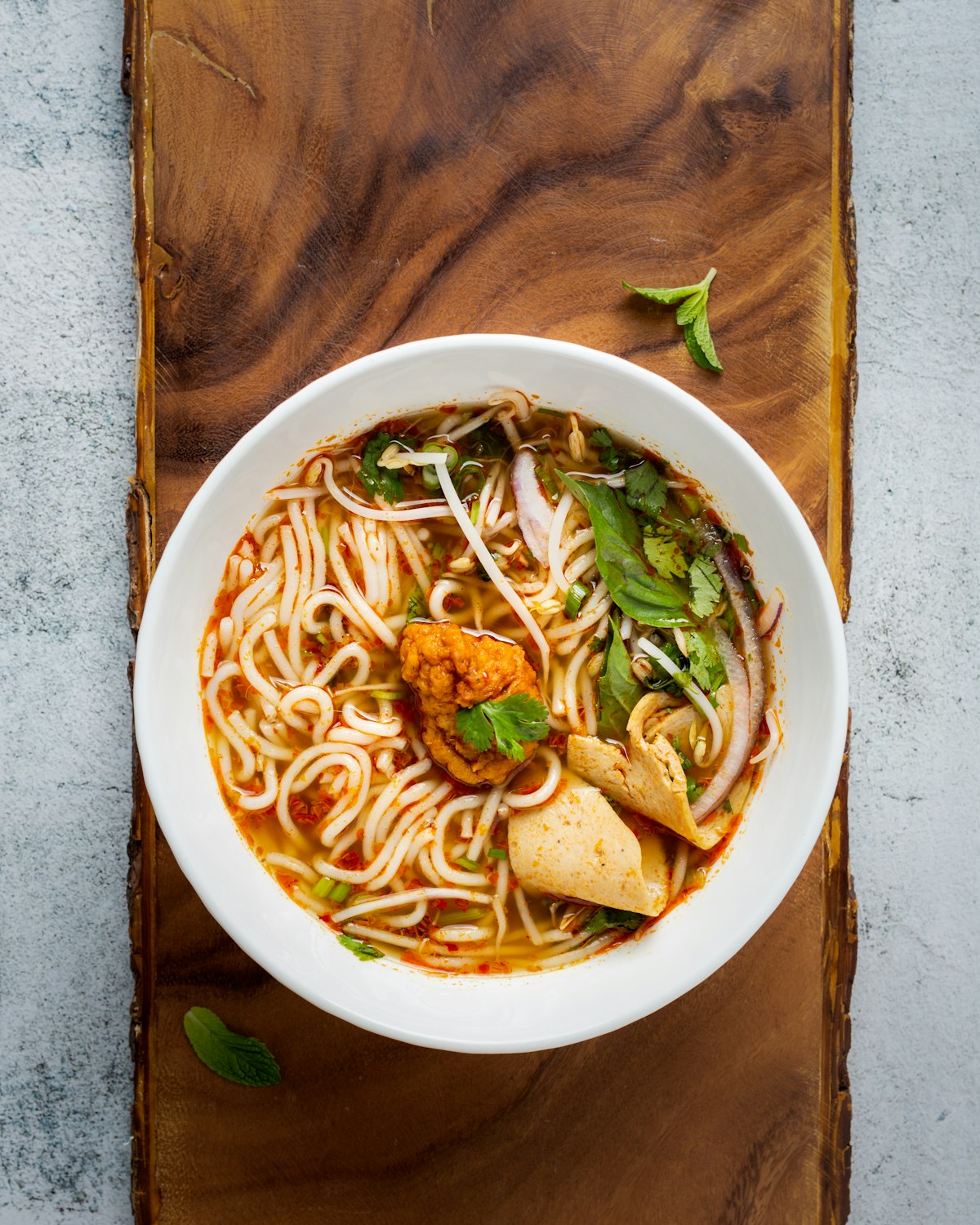
Ask an Italian if noodles and pasta are the same thing and you will get a firm no. Ask someone in China and you will get a similar answer, but for completely different reasons. They are both right.
The Ingredients
Italian pasta is almost always made from durum wheat semolina, sometimes with eggs. Durum wheat is high in gluten and gives pasta its firm, al dente bite. The flour is coarse, golden, and specifically milled for pasta making.
Asian noodles use a far wider range of flours. Wheat noodles (like ramen and udon) use regular wheat flour, not durum. Rice noodles use rice flour. Glass noodles use mung bean starch. Soba uses buckwheat. Sweet potato noodles use sweet potato starch. Some noodles add alkaline salts (kansui) which give them a springy, chewy texture and yellow colour, something pasta never does.
"The variety of noodles in China alone is staggering. Wheat, rice, mung bean, sweet potato, buckwheat. Pulled, cut, shaved, rolled, extruded. Every region has its own shape, its own texture, its own reason for existing."
Fuchsia Dunlop, Land of Fish and Rice
The Technique
Pasta is shaped. It is rolled, cut, extruded, or pressed into specific forms, each designed to hold sauce in a particular way. Penne catches sauce inside the tube. Spaghetti wraps around a fork. Orecchiette cups ragu. The shape is inseparable from the dish.
Noodles are more about texture than shape. Hand-pulled lamian in Lanzhou is stretched and folded to create uniform strands with a specific chewiness. Japanese udon is kneaded by foot to develop the gluten. Knife-cut noodles are shaved off a block of dough directly into boiling water, creating irregular shapes that catch broth. The technique is about the eating experience in your mouth, not how the noodle holds sauce.
The Sauce vs The Broth
This is arguably the biggest difference. Italian pasta is defined by its sauce. The pasta is the vehicle. Carbonara, bolognese, pesto, aglio e olio. The sauce is the star, and the pasta is chosen to complement it.
Asian noodles are more often defined by their broth, or by the complete dish. A bowl of pho is not noodles with broth on top. It is a unified thing. The broth, the noodles, the herbs, the meat: they are meant to be experienced together. A plate of pad thai is a complete dish where the noodles are stir-fried with everything else. The concept of "sauce on noodles" is less central in Asian noodle culture.
The Cultural Role
In Italy, pasta is a course within a meal. Primo comes after antipasto and before secondo. You eat pasta as one part of a structured dining experience.
In most of Asia, a bowl of noodles is the meal. It is complete in itself. You sit at a street stall or a noodle shop, eat your bowl, and leave. Noodles are fast food in the original sense: food served fast, eaten quickly, and endlessly satisfying. This is the culture that Noodle Crawl celebrates.
So Are They the Same?
No. They share a common ancestor, a history stretching back 4,000 years, in the sense that both involve flour and water formed into strands and cooked. But the ingredients, techniques, cultural contexts, and eating experiences are fundamentally different. Calling all noodles "pasta" or all pasta "noodles" misses what makes each of them great.
Both are brilliant. Both deserve respect on their own terms. But this is a noodle site, so we know which side we are on. If you want to see just how far noodles have come, check out our list of the 20 best noodle dishes in the world.