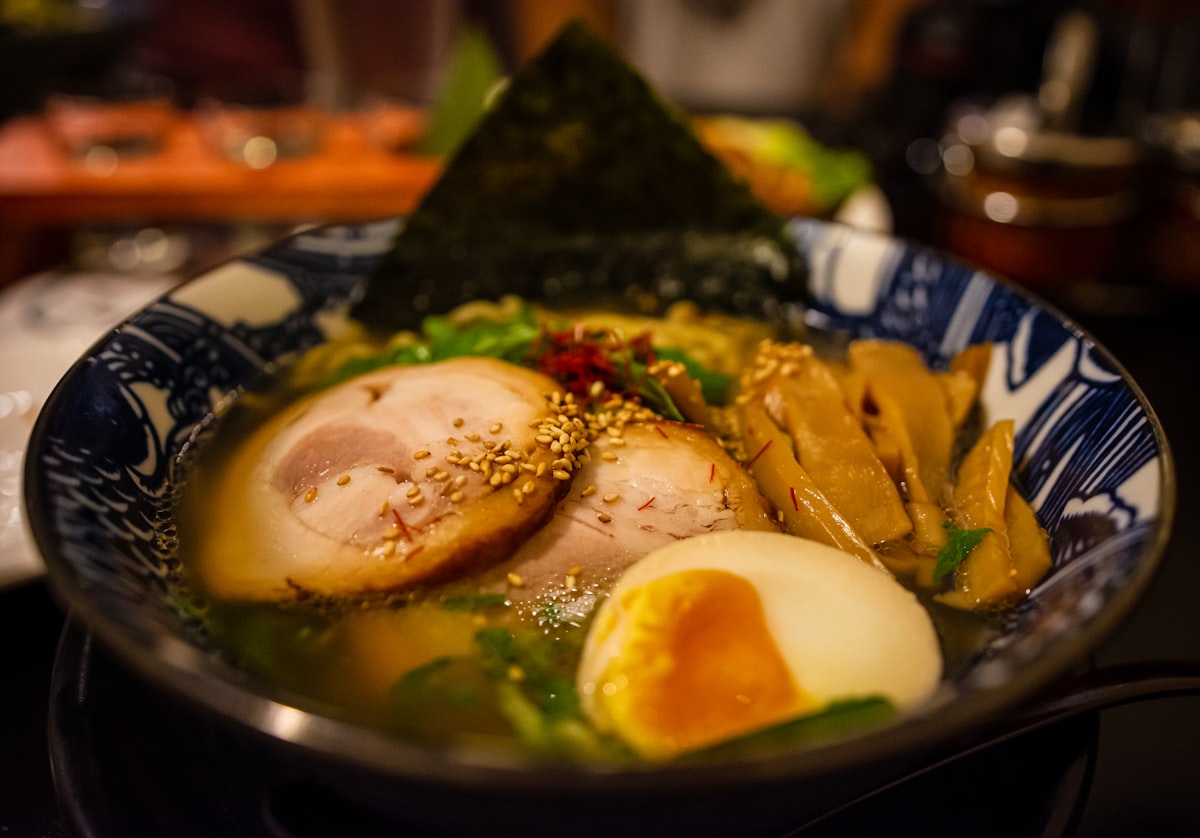
Ramen is a Japanese noodle soup that has become one of the most loved dishes on the planet. At its simplest, it is wheat noodles in a flavoured broth with toppings. In practice, it is one of the most complex and obsessively perfected foods in existence. A single bowl of ramen can represent days of preparation, and the best ramen shops in Japan treat their broth recipes like state secrets.
A Brief History of Ramen
Ramen's roots are Chinese. In the late 19th and early 20th centuries, Chinese immigrants brought wheat noodle soups to Japanese port cities like Yokohama and Kobe. The Japanese called it chuka soba, meaning Chinese noodles, and it was sold from small stalls and carts, often near railway stations. It was cheap, filling, and fast. The dish stayed relatively niche until after World War II. Food shortages and American wheat imports created the perfect conditions for ramen to explode. Wheat was cheap and available, rice was scarce, and people needed affordable, calorie-dense food.
By the 1950s, ramen had evolved from its Chinese origins into something distinctly Japanese. Regional styles developed across the country, each city putting its own stamp on the bowl. Then in 1958, Momofuku Ando invented instant ramen, and the dish went global almost overnight. But the real craft ramen movement, the one that turned ramen into a culinary obsession, took off in the 1980s and 1990s, when specialist ramen shops began competing to create the perfect bowl. Today, there are roughly 25,000 ramen shops in Japan, and the best ones draw queues that wrap around the block.
"Ramen is not just a bowl of soup. It is an obsession. In Japan, people will queue for two hours in the rain for a bowl they have been thinking about all week."
Ivan Orkin, Ivan Ramen: Love, Obsession, and Recipes from Tokyo's Most Unlikely Noodle Joint
The Four Main Broth Types
Ramen broth is classified by its seasoning (tare), and there are four main types. Understanding these is the key to understanding the entire ramen landscape.
Shoyu (soy sauce) is the original and most common style. The broth is typically clear to brown, made from chicken or pork stock seasoned with soy sauce. It has a savoury, slightly tangy flavour with moderate richness. Tokyo-style ramen is the classic shoyu bowl: refined, balanced, and not too heavy. A great shoyu ramen lets you taste every component clearly.
Shio (salt) is the lightest and most delicate of the four. The broth is usually pale and clear, seasoned primarily with salt. It relies heavily on the quality of the base stock, since there is nowhere to hide. The best shio ramen has a clean, almost ethereal flavour. Think of a perfectly made chicken consomme with Japanese aromatics. Hakodate in Hokkaido is famous for its shio ramen.
Miso ramen uses fermented soybean paste as its tare. It is robust, earthy, and deeply savoury, with a richness that comes from the miso itself. Sapporo in Hokkaido is the spiritual home of miso ramen, where it was invented in the 1960s. The broth is often paired with butter and corn, and the noodles tend to be thick and wavy to hold the heavy soup. Miso ramen is winter food, the kind of bowl that warms you from the inside out.
Tonkotsu (pork bone) is the heavyweight. The broth is made by boiling pork bones at a hard rolling boil for 12 to 20 hours, until the collagen breaks down and the liquid turns opaque, creamy, and almost milky white. It is intensely rich and porky. Hakata in Fukuoka is ground zero for tonkotsu ramen, where they serve it with ultra-thin straight noodles and offer kaedama, an extra serving of noodles to add to your remaining broth. Tonkotsu is probably the style that converted most of the Western world to serious ramen.
Noodle Types
Ramen noodles are made from wheat flour, water, salt, and kansui, an alkaline mineral water that gives the noodles their characteristic yellow colour, springy texture, and slightly slippery surface. The type of noodle varies by region and broth style, and a good ramen shop matches its noodles precisely to its soup.
Thin, straight noodles are the standard for tonkotsu ramen. They cook fast, absorb the rich broth quickly, and are meant to be eaten before they go soft, which is why Hakata ramen shops push you to choose your noodle firmness (kata for firm, bari kata for very firm, harigane for barely cooked). Thick, wavy noodles are the choice for miso ramen, where the curls trap the heavy broth. Medium-thickness wavy noodles work well with shoyu and shio, providing enough body to stand up to the soup without overwhelming it. Some shops make their own noodles in-house; others work with specialist noodle manufacturers who supply custom formulations.
Essential Toppings
The toppings in a bowl of ramen are not afterthoughts. Each one is deliberately chosen to complement the broth and noodles, adding texture, flavour, or visual contrast.
Chashu is braised pork, usually belly or shoulder, slow-cooked in soy sauce, mirin, and sake until it is meltingly tender. The best chashu is torched with a blowtorch just before serving, giving it a caramelised edge. Ajitama is a marinated soft-boiled egg with a jammy, orange yolk, soaked in a soy-based tare. It is ramen's most photogenic topping. Nori (dried seaweed) adds a briny, umami note and a satisfying crunch when you bite through it. Menma (fermented bamboo shoots) provides a tangy, slightly crunchy counterpoint to the rich broth. Negi (sliced spring onion) adds freshness and a mild sharpness. Other common additions include wood ear mushrooms (kikurage), bean sprouts, spinach, corn, butter, garlic, and mayu (blackened garlic oil).
Regional Styles Worth Knowing
Japan's regional ramen styles are fiercely local and fiercely defended. Each one reflects the climate, ingredients, and food culture of its area.
Sapporo (Hokkaido) is synonymous with miso ramen. The cold climate demands something rich and warming, and Sapporo delivers with a thick miso broth often topped with butter, corn, and stir-fried vegetables. The noodles are thick and wavy. Hakata (Fukuoka) is the capital of tonkotsu. The broth is milky white and deeply porky, the noodles are thin and firm, and the portions are small enough that ordering a second helping of noodles (kaedama) is standard practice. Tokyo is the home of shoyu ramen: a clear, soy-sauce-seasoned broth with curly noodles, chashu, menma, nori, and negi. It is the ramen archetype. Kitakata in Fukushima is known for thick, flat, hand-wavy noodles in a light pork and niboshi (dried sardine) shoyu broth. There are more ramen shops per capita in Kitakata than almost anywhere else in Japan.
Beyond these big four, there is Wakayama's dark, pork-bone shoyu ramen. There is Tokushima's sweet, pork-heavy broth served with a raw egg on top. There is Asahikawa's double-soup style that blends pork bone and seafood broths. And there is tsukemen, a style of dipping ramen where the noodles are served cold and dipped into a concentrated broth on the side, a style popularised by the legendary Taishoken shop in Tokyo.
Modern Ramen and the Craft Movement
The last two decades have seen ramen evolve from street food to craft cuisine. A new generation of ramen chefs, many of them trained in French or Italian kitchens, are applying fine-dining techniques to the bowl. You now see ramen made with high-end ingredients like wagyu, truffle, and aged parmesan. Shops experiment with unusual broths: clam, lobster, whole chicken, or dashi-forward styles that strip things back to pure Japanese flavour.
The Michelin Guide has awarded stars to ramen shops in Tokyo, something that would have been unthinkable a generation ago. Tsuta, a tiny nine-seat shoyu ramen shop in Sugamo, became the first ramen restaurant to earn a Michelin star in 2015. The craft ramen movement has also gone global, and cities like New York, London, Sydney, and Bangkok now have serious ramen shops run by obsessive cooks who source their own noodles and simmer their broths for 20 hours.
How to Eat Ramen
There is a right way and it is simple. Eat fast. Ramen is not a dish to savour slowly. The noodles are designed to be eaten quickly before they absorb too much broth and go soft. Use your chopsticks to lift the noodles and slurp them. Slurping is not just acceptable in Japan, it is expected. It aerates the noodles and cools them down. Use the spoon to drink the broth between bites of noodles. Taste the broth first, before you add anything, to appreciate what the chef has built. Then season to taste. Most ramen shops have condiments on the table like garlic paste, chilli oil, sesame seeds, and white pepper.
We are mapping the best ramen spots in Tokyo for an upcoming city launch. In the meantime, see where ramen ranks on our list of the best noodle dishes in the world, or explore our other noodle guides to keep your bowl knowledge sharp.